
Coca (Erythroxylum coca) has been a staple of Andean culture for millennia. Indigenous peoples traditionally chew coca leaves (“acullico”) mixed with a bit of alkaline ash or lime, slowly releasing its mild stimulants[1][2]. This suppresses hunger and fatigue, eases stomach aches, and even helps with high-altitude discomfort[2][3]. Coca tea is likewise consumed for energy and digestive relief[3]. There is also growing use of coca leaf flour as a supplement in breads and foods[4]. (For context, analyses show ~5 g of coca flour yields <10% of most daily nutrients[5], so doses are typically small.) Importantly, coca is considered sacred in Andean rituals, used as an offering and symbol of heritage[6][2]. In this article we know about Coca Leaf Nutrition, and more.
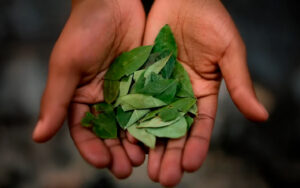
- Chewing (Acullico): Wads of leaves + ash placed in the cheek, providing a slow-release stimulant (akin to a very mild caffeine). This traditional use curbs fatigue and suppresses appetite[1][2].
- Coca Tea (Mate de Coca): Hot-water infusions of coca leaves are popular for indigestion, nausea relief and general stamina[3]. A cup of coca tea (~1–2 g leaf) acts like a weak coffee (mild alertness, little buzz)[3].
- Coca Flour/Supplements: Dried leaf powder is used in foods and health products. (In Peru/Bolivia it may be added to breads or nutrition programs[4].) However, even a couple of teaspoons (≈5 g) contribute very modest nutrients[5].
These practices highlight that the whole leaf is valued as a tonic. Only a small portion of the leaf’s nutrients are absorbed from tea or chewing – yet over a day (Andean chewers often use 30–60 g of leaf) the intake can significantly supplement minerals like calcium and iron[7][3].
Coca Leaf Nutrition:
Coca leaves are unusually rich for a leafy plant. Analyses of dried coca leaves show:
- Protein: about 6–20 g per 100 g (dry weight)[8][9]. (Different studies vary: Duke et al. found ~18.9 g/100g[8], while Penny et al. found ~20.3 g[9]; one Colombian sample reported ~6–10 g in leaves[10].) This is comparable to many grains.
- Carbohydrates: 40–80 g per 100 g, mostly simple sugars and fiber[8][11]. For example, Duke found 46.2 g/100g[8], while a recent study reported ~71–78 g/100g[11]. These include glucose, fructose and sucrose[11].
- Fat: very low, roughly 1–5 g per 100 g[12][13]. (Duke measured ~5.0 g total fat[12]; another study found mostly 0.1–3.4 g of “ether extract”[13].)
- Fiber: Extremely high – 10–60 g per 100 g. Older data gave ~14.4 g[14], but newer analyses show total dietary fiber often >50 g/100g, mostly insoluble[15]. For instance, one report found 54–84 g/100g of dietary fiber in dried leaves and stems[15]. (By comparison, most vegetables and grains have <5–10 g/100g.)
In short, a 100-gram serving of dried coca provides on the order of 300 calories, with significant protein and mostly complex carbs/fiber[8]. The extraordinarily high fiber is noteworthy: coca leaf fiber is much greater than typical vegetables (which are usually ~2–6 g/100g)[14][15]. This fiber is primarily insoluble (cellulose, lignin) which can aid digestion and gut health.
Vitamins and Minerals
Coca leaves are packed with certain micronutrients. Key values per 100 g dried leaf (cited from analyses) include:
- Vitamin A (as β-carotene): ~3.5 mg (≈6,000 IU)[9]. (Duke found an even higher value ~11,000 IU[8].) This is a very large amount for a leafy plant.
- B-Vitamins: Moderate amounts. Riboflavin (B₂) ~1.9 mg[8]; thiamin (B₁) ~0.35 mg[16]; niacin ~1.3 mg[16]; vitamin B₆ ~0.5 mg[17]. These help energy metabolism.
- Vitamin E: ~17 mg/100g[17] (as α-tocopherol). (Duke found ~43 IU, i.e. ~29 mg, in one sample[18].)
- Vitamin C: Very low. Only about 1–2 mg/100g was found in dried leaves[19], since vitamin C is destroyed by drying. (Fresh leaves may have more, but typical preparation involves drying/curing.)
- Calcium: 1,000–1,500+ mg per 100 g. Coca stands out for its calcium. Duke’s Bolivian sample had 1,540 mg[20]; Penny et al. (Peru) measured ~990–1033 mg[21]. Either way, this is very high – far above most common foods.
- Iron: 30–45 mg per 100 g. Duke found 45.8 mg[20]; Penny found ~29.2 mg[21]. Again, these are unusually high for a plant (typical vegetables have 2–5 mg).
- Phosphorus: ~900–910 mg[20] (e.g. Duke measured 911 mg[20]).
- Magnesium: ~200–220 mg[22].
- Potassium: on the order of 5–2.5 g. (For instance, Duke’s leaf had ~2.02 g[23].)
- Other minerals: Zinc ~2.6–2.7 mg, copper ~1.2 mg[22], plus trace amounts of manganese, selenium, etc. Sodium is very low (a few dozen mg).
These values mean that 100g of dried coca can meet or exceed adult RDAs for Ca, Fe, and many B-vitamins. (By contrast, most leafy greens have <100 mg Ca/100g and only a few mg of iron.) For example, no common vegetables match coca’s Ca: Duke notes that even sesame seeds (high-Ca seed) have 1,212 mg/100g[24], still below coca’s ~1,500 mg. Likewise, coca’s iron (30–45 mg) dwarfs typical green vegetables (2–5 mg).
Connecting to diet:
Even small coca servings can help nutrient intake. One analysis compared 5 g coca powder to normal foods and found it adds only modest nutrients (e.g. <10% of RDA for most key nutrients)[5]. However, Andean coca chewers may use 30–60 g/day[7], which could supply large amounts of Ca and Fe. In fact, an Andean paper noted that 60 g of coca leaf alone “more than satisfies [the chewer’s] requirements for calcium”[7]. Of course, such a large intake is unusual outside traditional use, and many nutrients will remain bound or pass through (see below).
Antioxidants and Phytochemicals
Beyond vitamins/minerals, coca leaves contain polyphenols and flavonoids – natural antioxidants found in many plants. Recent analyses report:
- Total phenolic content: Coca leaves can have on the order of 100–1,000 mg gallic-acid equivalents (GAE) per 100 g dry weight. For example, one Peruvian-type coca (“Caimo” variety) had 10.534 mg GAE per g (i.e. ~1,053 mg/100g)[25], whereas another variety (“Palo”) had only ~1.176 mg/g (~118 mg/100g)[25].
- Flavonoids: These specific antioxidants (like quercetin) were measured at up to ~0.213 mg quercetin equivalents per g (≈21 mg/100g) in the high-phenolic sample[25]. (The Palo leaves were lower, ~0.074 mg/g[26].) Coca contains flavonoids such as quercetin and kaempferol, which are common in many fruits and teas[27].
- Antioxidant capacity: By a DPPH assay (Trolox equivalents), coca showed up to ~0.696 mg Trolox/g (≈69.6 mg/100g) in the high-phenolic sample[28]. This indicates a moderate antioxidant potential, comparable to many berries and teas on a weight basis.
In short, coca leaf is rich in plant polyphenols. These compounds are associated with anti-inflammatory and antioxidant effects in laboratory tests. For example, a WHO review notes that coca extracts have “antioxidant” and “anti-inflammatory” properties[29]. (However, human studies are limited.)
Along with antioxidants, coca contains various alkaloids (nitrogenous stimulants). The chief alkaloid is cocaine, but others (benzoylecgonine, cuscohygrine, etc.) are present[23]. Cocaine content in dried leaves is low – typically 0.2–0.6% by weight (one review gives 0.23–0.96% with an average 0.63% for Andean coca). These alkaloids contribute the stimulant effect but represent a very small fraction of the leaf’s mass. (By contrast, the antioxidant polyphenols weigh hundreds of milligrams per 100 g – orders of magnitude more.)
Bioavailability and Safety
Absorption of nutrients.
Chewing or brewing coca helps extract some nutrients, but not all. One clinical study of coca chewing found excellent release of vitamins: 100% of the leaf’s thiamin was recovered in saliva, and 62% of its vitamin A (carotene)[30]. Riboflavin recovery was ~37%[30]. Thus, a good portion of the water-soluble vitamins can be absorbed. However, like other leafy greens, coca also contains compounds (phytates, oxalates, tannins) that can bind minerals. For example, high fiber and oxalate might reduce how much calcium or iron actually gets absorbed. In theory, consuming coca with a source of vitamin C (e.g. lime juice in chewing) could enhance iron absorption[31], just as it does for other plant foods.
Typical intakes.
Modern nutritional use of coca usually involves small amounts. A standard teabag of mate de coca has ~1–2 g of leaves. Andean traditional use is higher: some chewers use 30–60 g of fresh (≈6–12 g dried) per day[7]. At that high level, Coca can contribute meaningful nutrients – e.g. 60 g of leaf contains nearly 1 g of calcium[7]. (For perspective, that alone covers most daily calcium needs.) But most coca is not eaten, only chewed or steeped. Any nutrients not released remain largely unabsorbed. For example, because vitamin C is so low in dried leaf, coca tea provides almost no vitamin C, so its iron uptake may not be as high as the raw numbers suggest.
Stimulant and alkaloid effects.
Because of the cocaine alkaloid, coca requires care. However, in traditional use “no fatal overdoses have been reported”[32]. At low doses coca acts like a mild caffeine substitute: it increases alertness and stamina without the strong euphoria of pure cocaine[32]. For example, a cup of coca tea (1 g leaf) contains only ~4 mg of cocaine alkaloid[33] – much less than a medical dose. (By comparison, a “line” of powdered cocaine is ~20–30 mg.) Still, repeated use of cocaine is addictive, so coca chewing can carry some risk of dependence, though anthropological studies find low addiction rates among traditional users[32]. Local effects are more common – some users report mild mouth/throat irritation from chewing[32].
Safety cautions:
In modern agricultural practice, coca leaves may carry pesticide residues (cheaper growers time harvest to avoid rain, but they aren’t washed[34]). Moreover, the cumulative exposure to alkaloids should be considered. One Duke analysis noted an average annual copper intake of ~442 mg from chewing coca – not toxic, but worth noting[35]. In essence, while coca has nutritional value, “the presence of alkaloids and possible insecticide residues suggest caution”[34]. Health-wise, anyone with heart or blood pressure issues should be careful with coca’s mild stimulants. Also, because vitamin C is negligible, it’s not a source of that antioxidant.
Legal status.
It is vital to note that whole coca leaf is illegal in many countries under international drug laws. The 1961 UN Single Convention placed coca leaf in Schedule I (alongside cocaine and heroin)[36], aiming to phase out its use. Today, only decocainized coca extract is allowed worldwide (e.g. for flavoring cola drinks). However, traditional coca use is formally legal in several Andean nations. Bolivia and Peru both recognize coca chewing as cultural heritage, allowing sale of dried leaf in markets. Colombia has a “grey area” where leaf use is tolerated among indigenous communities[36]. Anyone outside these countries should be aware that bringing or using coca leaves may violate local laws.
Comparison with Common Foods
To give context, coca’s nutrient levels far exceed those in most familiar foods. For example:
- Calcium: 100g coca (≈1,000–1,500 mg) vs ~120 mg in 100g cow’s milk[37][24]. (Coca’s Ca even rivals high-Ca seeds: sesame seeds have ~1,212 mg[24].)
- Iron: 100g coca (~30–45 mg) vs ~2–3 mg in 100g spinach or ~1–2 mg in carrots[14][37].
- Protein: 100g coca (~18–20 g) is comparable to a serving of wheat or rice flour, and much higher than leafy vegetables.
- Fiber: Dried coca (~15–60 g) far exceeds, say, wheat bread (~5–8 g) or fruits (~2–3 g).
- Vitamins: Coca’s riboflavin (B₂ ~1.9 mg) is higher than most vegetables. Its vitamin A (~6,000–11,000 IU) surpasses carrots or spinach per weight.
In short, on paper coca leaf is nutrient-dense, especially in minerals and fiber. Yet, because we normally eat only small amounts (tea cups or quids), we don’t actually “consume” 100g at once. It’s more realistic to compare a teaspoon or cup: e.g., one cup of mate de coca might deliver a small fraction of those nutrients (perhaps 10–20 mg Ca, a couple mg iron). Studies show that even two tablespoons of coca flour give <10% of RDA for key vitamins in children or adults[5].
Conclusion
Coca leaves are a complex nutritional supplement. They contain a broad spectrum of macronutrients (notably high fiber) and are rich in certain vitamins and minerals (especially Ca, Fe, and carotene)[8][9]. The leaves also supply antioxidant polyphenols and mild bioactive alkaloids. Traditional Andean use – chewing or tea – extracts some of these benefits, which helps explain coca’s cultural importance. However, the bioavailability of these nutrients in humans is not fully established, and only small portions are typically consumed, so its impact on modern diets is limited[5][38].
Most importantly, coca’s nutritional virtues must be balanced against safety and legal issues. The cocaine and other alkaloids, while mild in the leaf, are controlled substances; and residues or overconsumption can pose risks[23][32]. As one review bluntly concluded: coca leaf “does not provide nutritional benefits when eaten in the recommended quantities, and…the presence of…alkaloids may be potentially harmful”[5].
For health-conscious readers, the takeaway is that coca leaf is an unusual plant food: it truly contains vitamins, minerals and antioxidants at levels well above most plants. In the Andes it has long been used to ward off malnutrition and fatigue. But outside that context, legal restrictions and health cautions limit its use. Any consideration of coca as a “superfood” must note these limitations.
Sources: Nutrient analyses of coca leaves[8][9][22][39]; antioxidant studies[25]; ethnobotanical and safety reviews[2][32][40][23], among others. All values and claims above are drawn from peer-reviewed research and authoritative reviews.